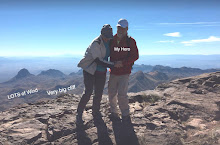
Join me in a harmless fantasy. Based on more than superficial exposure to their craft, you're confident two creative artists from differing fields would be excellent collaborators. For example, a composer and a filmmaker or a conceptual artist and an author or a sculptor and a playwright. For which two artists would you enjoy brokering an introduction? Let your imagination run free and share it with me and others.
A few years ago, after enjoying his music for a long time and his lyrics since "West Side Story" made me want to own a purple shirt and dance in the streets, I read Stephen Sondheim's two part memoir - "Finishing The Hat" and "Look I Made A Hat". Based on Sondheim's comments in those books about the craft of lyric writing, arranging to introduce author Julian Barnes to Stephen Sondheim so that they might collaborate gives me gooseflesh.
I'm confident if I could get these two giants together, their joint efforts would be superb. Reading Barnes's most recent book ("Levels of Life"), it was hard not to hear Sondheim's dark score from "Sweeney Todd". But beyond that unmistakable synaptic spark was even more. Sondheim's approach to lyrics and Barnes's prose are of a piece - elegant, simple and concise. Sondheim simply must read "Flaubert's Parrot" or "Arthur and George" or "The Sense Of An Ending"; any of those Barnes novels will inspire him.
So, I arrange this introduction and then not long after, a Broadway musical opens: "Before She Met Me" - Music & lyrics - Stephen Sondheim; book by Julian Barnes. I won't even ask for a broker's fee. Who are you going to get together and what will their joint effort be?
Saturday, November 16, 2013
Thursday, November 14, 2013
Is There A Nice Way To Say This?
Simple words pack a great deal of punch. Fear, grace, trust - each speaks volumes with one syllable. And then there is "nice".
"Have a nice day", "what a nice guy", "buy her something nice". We're way past cliche here. Though there are surely people who would relish being called nice, my guess is most of them would prefer being called gracious or kind or enjoyable. Don't each of those alternatives conjure more specific behaviors than nice?
A good friend of many years is the most decent and even tempered man I've ever met; my wife is a person with a rock-solid core of integrity, generosity and non-smarmy charm; the new neighbor I just met strikes me as straightforward. Are these all euphemisms for nice? Am I splitting hairs? Didn't I start out saying simple words pack a great deal of punch? Perhaps, probably, yes. But tell me your preference. Being described as nice (or... it's two syllable equivalent - "pleasant")? Being described more specifically? Or...if someone can't come up with something better than nice, not described at all?
Enjoy your day and be sure to get her something thoughtful.
"Have a nice day", "what a nice guy", "buy her something nice". We're way past cliche here. Though there are surely people who would relish being called nice, my guess is most of them would prefer being called gracious or kind or enjoyable. Don't each of those alternatives conjure more specific behaviors than nice?
A good friend of many years is the most decent and even tempered man I've ever met; my wife is a person with a rock-solid core of integrity, generosity and non-smarmy charm; the new neighbor I just met strikes me as straightforward. Are these all euphemisms for nice? Am I splitting hairs? Didn't I start out saying simple words pack a great deal of punch? Perhaps, probably, yes. But tell me your preference. Being described as nice (or... it's two syllable equivalent - "pleasant")? Being described more specifically? Or...if someone can't come up with something better than nice, not described at all?
Enjoy your day and be sure to get her something thoughtful.
Tuesday, November 12, 2013
It's "About" The Heart
"The heart against itself": William Faulkner
Finishing "The House On Fortune Street" (2008) by Margot Livesey, all I could think of were Faulkner's words the year he won the Nobel Prize. Four pages from the end of this stunning book, I paused to emotionally inoculate myself. Then I completed it and took a long cleansing walk.
How do you respond when someone asks you "What was that book about?" As with any terrific novel, I might have difficulty being so reductive if asked this question about Livesey's book. It's about everything really. Or at least everything that matters. It's also full of beautiful language and those insights that talented authors seem to have an ample supply of - "My own theory is that we only suspect people of our own faults, which is to say you're too honest to suspect...deceit".
"... a detective story of the heart." Spotting that phrase on the book jacket I wondered if whoever wrote it was also thinking of Faulkner's words after reading "The House On Fortune Street". When you finish it, tell me what word jumps out for you.
Finishing "The House On Fortune Street" (2008) by Margot Livesey, all I could think of were Faulkner's words the year he won the Nobel Prize. Four pages from the end of this stunning book, I paused to emotionally inoculate myself. Then I completed it and took a long cleansing walk.
How do you respond when someone asks you "What was that book about?" As with any terrific novel, I might have difficulty being so reductive if asked this question about Livesey's book. It's about everything really. Or at least everything that matters. It's also full of beautiful language and those insights that talented authors seem to have an ample supply of - "My own theory is that we only suspect people of our own faults, which is to say you're too honest to suspect...deceit".
"... a detective story of the heart." Spotting that phrase on the book jacket I wondered if whoever wrote it was also thinking of Faulkner's words after reading "The House On Fortune Street". When you finish it, tell me what word jumps out for you.
Monday, November 11, 2013
My Unsung Hero
Thank you, Dad. Thank you, veterans.
I cannot recall another film that hit me as hard emotionally as "Saving Private Ryan". Though I haven't yet summoned the nerve to watch it a second time, the early scenes of the landing at Normandy Beach are fresh in my mind fifteen years later. I also clearly recall what I thought watching it - my Father lived this.
Because my Dad died shortly before "Saving Private Ryan" was released, it's likely my reaction to this movie was intensified by that recent loss. Yet even now when I try describing the film to someone, my throat tightens up. No doubt these feelings are tied to my strong admiration for my Father. In every important sense, he was my hero.
It's unlikely I will ever experience anything close to what my Dad did as a 26 year old. Every thing good I am as a man, I owe to him.
I cannot recall another film that hit me as hard emotionally as "Saving Private Ryan". Though I haven't yet summoned the nerve to watch it a second time, the early scenes of the landing at Normandy Beach are fresh in my mind fifteen years later. I also clearly recall what I thought watching it - my Father lived this.
Because my Dad died shortly before "Saving Private Ryan" was released, it's likely my reaction to this movie was intensified by that recent loss. Yet even now when I try describing the film to someone, my throat tightens up. No doubt these feelings are tied to my strong admiration for my Father. In every important sense, he was my hero.
It's unlikely I will ever experience anything close to what my Dad did as a 26 year old. Every thing good I am as a man, I owe to him.
Sunday, November 10, 2013
Questions And Possibilities
"I dwell in possibility...": Emily Dickinson
Creativity, leadership, self-help - however one categorizes "The Art Of Possibility" by Rosamund Stone Zander & Benjamin Zander, it is worth any discerning reader's time. Each of the twelve practices outlined by the authors is approached via their complementary disciplines - psychology and art. I recall first being exposed to this potent mix in the early 90's when developing a leadership course and learning the Harvard Business Review endorsed poetry as a viable leadership tool.
"It's all invented." That simple but powerful sentence, the core of the first practice, helps set the tone for all that follows in "The Art of Possibility". The Zanders are strong believers in constructivism, i.e. "We don't see the world as it is, but as we are." As with nearly every worthwhile book I've read about leadership, a crucial part of the fabric are questions a thinking person must continually ask themselves. For example:
"What assumption am I making that I'm not aware I'm making that gives me what I see?" or...
"Who am I being that they are not shining?"
And though the crux of the latter question is aimed at a leader/subordinate relationship, I transplanted it to my role as a parent, sibling, friend. I've always tried to be the kind of person who helps others flourish. It's possible I could be a lot more effective doing so if I periodically asked myself this question. Why not try it with me and tell me how it goes?
Creativity, leadership, self-help - however one categorizes "The Art Of Possibility" by Rosamund Stone Zander & Benjamin Zander, it is worth any discerning reader's time. Each of the twelve practices outlined by the authors is approached via their complementary disciplines - psychology and art. I recall first being exposed to this potent mix in the early 90's when developing a leadership course and learning the Harvard Business Review endorsed poetry as a viable leadership tool.
"It's all invented." That simple but powerful sentence, the core of the first practice, helps set the tone for all that follows in "The Art of Possibility". The Zanders are strong believers in constructivism, i.e. "We don't see the world as it is, but as we are." As with nearly every worthwhile book I've read about leadership, a crucial part of the fabric are questions a thinking person must continually ask themselves. For example:
"What assumption am I making that I'm not aware I'm making that gives me what I see?" or...
"Who am I being that they are not shining?"
And though the crux of the latter question is aimed at a leader/subordinate relationship, I transplanted it to my role as a parent, sibling, friend. I've always tried to be the kind of person who helps others flourish. It's possible I could be a lot more effective doing so if I periodically asked myself this question. Why not try it with me and tell me how it goes?
Saturday, November 9, 2013
You Read It Here First
As claims-to-fame go this is embarrassingly pathetic. But remember you read it here first - The 21st century public restroom experience is ripe for a comedy routine. Feel free to forward this post to a favorite comic.
All that currently stands in the way of the experience being hands-free are automated doors and toilet paper dispensers. When those two technologies are (inevitably) installed, all we'll have to touch when using a public restroom will be our clothes and private parts. Will a technology be subsequently developed making even that unnecessary?
How many of you have put your hands under a faucet as I have for a few seconds before realizing there was something quaint you forgot to turn to get the needed water? Ever waved your hands in front of a towel dispenser and then waited in vain? Oops. I'm still not used to the automated soap thing or those deafening hand dryers. And guys, excuse the indelicacy but don't blame me if I leave something in the bowl or urinal, OK? I'm bound to forget now and then given how many public toilets don't require the use of opposable thumbs. Worst of all, what about hybrid bathrooms with one or two of the technologies but not the others? Come on.
This post was inspired by my local public library, a place I love for many reasons, not least of which the restroom is so 20th century.
All that currently stands in the way of the experience being hands-free are automated doors and toilet paper dispensers. When those two technologies are (inevitably) installed, all we'll have to touch when using a public restroom will be our clothes and private parts. Will a technology be subsequently developed making even that unnecessary?
How many of you have put your hands under a faucet as I have for a few seconds before realizing there was something quaint you forgot to turn to get the needed water? Ever waved your hands in front of a towel dispenser and then waited in vain? Oops. I'm still not used to the automated soap thing or those deafening hand dryers. And guys, excuse the indelicacy but don't blame me if I leave something in the bowl or urinal, OK? I'm bound to forget now and then given how many public toilets don't require the use of opposable thumbs. Worst of all, what about hybrid bathrooms with one or two of the technologies but not the others? Come on.
This post was inspired by my local public library, a place I love for many reasons, not least of which the restroom is so 20th century.
Friday, November 8, 2013
Anchoring In A Post 9-5 Life
With respect to hours, the second half of my full time working years were significantly more routine than the first half. And one aspect of a predictable 9-5 working life I came to appreciate was how easy it was to integrate important disciplines into a schedule like that.
For example, though I'd always been committed to staying fit, establishing an exercise regimen with the erratic hours in my first 20 years working full time proved very challenging for me. The 9-5 routine was much easier to use to my advantage. Scheduled to begin work at 9:00? OK, take a few minutes to journal before starting. Driving home from work at 5:00? OK, exercise before getting ready for dinner. I quickly discovered this technique of anchoring one thing to another was highly effective in making disciplines stick. Recognizing how these disciplines had become essential to my mental health, as I prepared to transition out of full time work in early 2010, I planned ways to keep them all humming after my 9-5 life ended.
One discipline I've struggled to fully re-integrate is my meditation practice. It's possible this is so because unlike journalling (where there is an end product) or exercising (where fitness can be measured) or practicing guitar (where new songs are added to an existing repertoire), the benefits of meditation are more difficult to quantify. So even though I know it helps me, being unable to identify a tangible benefit may have put it back further in my mental queue. In addition, the 9-5 anchoring technique I used for this discipline was pulling into a parking space wherever I worked and then meditating in the car. Though I'm committed to finding a new anchoring technique to help me fully re-integrate my meditation practice, spending more time in the car is not in the cards.
For example, though I'd always been committed to staying fit, establishing an exercise regimen with the erratic hours in my first 20 years working full time proved very challenging for me. The 9-5 routine was much easier to use to my advantage. Scheduled to begin work at 9:00? OK, take a few minutes to journal before starting. Driving home from work at 5:00? OK, exercise before getting ready for dinner. I quickly discovered this technique of anchoring one thing to another was highly effective in making disciplines stick. Recognizing how these disciplines had become essential to my mental health, as I prepared to transition out of full time work in early 2010, I planned ways to keep them all humming after my 9-5 life ended.
One discipline I've struggled to fully re-integrate is my meditation practice. It's possible this is so because unlike journalling (where there is an end product) or exercising (where fitness can be measured) or practicing guitar (where new songs are added to an existing repertoire), the benefits of meditation are more difficult to quantify. So even though I know it helps me, being unable to identify a tangible benefit may have put it back further in my mental queue. In addition, the 9-5 anchoring technique I used for this discipline was pulling into a parking space wherever I worked and then meditating in the car. Though I'm committed to finding a new anchoring technique to help me fully re-integrate my meditation practice, spending more time in the car is not in the cards.
Tuesday, November 5, 2013
Electing To Eat At Home
Given my political stance, having breakfast at the local diner on Election Day was unwise. Since the likelihood any of the regulars from there read my blog is close to zero, it's probably safe to ask - Do these people consider their loud political conversations might be potentially offensive? And, do they think about other patrons unable to avoid overhearing them who don't share their views?
I'm as opinionated as the next obnoxious person; my siblings would likely say more so. But in public places, I try hard to make sure my loud talking doesn't spill into the political arena. Not long ago, my wife and I were having dinner out with a couple who largely share our political views. How often do you do the opposite? In any case, when one of them began getting a little loud, I was hyper-aware of other diners and tactfully shifted the conversation to a more neutral subject. Some would call this cowardice; I consider it courteous and this from someone not widely touted for that particular social grace.
Is the trend toward loud & public political posturing worse now than ever? Having never been a "those were the good old days" type, I suspect not. But next Election Day, especially since it's a mid-term, I'm staying away from the diner.
I'm as opinionated as the next obnoxious person; my siblings would likely say more so. But in public places, I try hard to make sure my loud talking doesn't spill into the political arena. Not long ago, my wife and I were having dinner out with a couple who largely share our political views. How often do you do the opposite? In any case, when one of them began getting a little loud, I was hyper-aware of other diners and tactfully shifted the conversation to a more neutral subject. Some would call this cowardice; I consider it courteous and this from someone not widely touted for that particular social grace.
Is the trend toward loud & public political posturing worse now than ever? Having never been a "those were the good old days" type, I suspect not. But next Election Day, especially since it's a mid-term, I'm staying away from the diner.
Subscribe to:
Posts (Atom)