Since flattering myself that I'd invented a clever metaphor months ago comparing the positions in basketball to the style of novelists, I've kicked around a follow up to that particular post. When I recently began writing it, using musicians this time instead of novelists, it dawned on me: I'm seriously out of touch vis-a-vis contemporary music.
Aside from my 23 year old daughter and my brother, who pays some attention to contemporary music, I know few people who help keep me tuned up in this regard. I seem to give more attention to newer novelists, filmmakers, and even visual artists than I do musicians. Very odd, given my passion for music. The youngest musician whose work I can speak of intelligently is over 50 years old - yikes. Came up with some strategies to assist myself - welcome others you might have:
* Put on college radio stations while driving; NPR goes on temporary hiatus
* Create more Pandora stations using contemporary artists - that's how I discovered Sara Bareilles
* Ask my daughter for future birthday and Christmas CD mixes featuring people she likes
* Engage more young adults (who are not Led Zeppelin or Eagles fans) about music they enjoy
That follow up? Postponed, until I'm more up-to-date.
Wednesday, October 24, 2012
Monday, October 22, 2012
A Long Ago Takeaway
Which long ago conversation still seems fresh in your memory based on something you learned from it?
I realize "long ago" means different things to us all. In my case, the conversation happened 40 years ago. But over the past day, listening to tributes for the late Senator George McGovern, that 1972 conversation with a college friend seems very fresh indeed.
Following college graduation in 1971, I was predictably liberal. So as the 1972 presidential election took shape, the candidate getting my vote was not in doubt. And my youthful enthusiasm for McGovern exceeded my sense of America's role in the world. So when a liberal friend said that he too would vote for McGovern, even though he felt Nixon better suited to the job, I recall being indignant. Was he right? Even with the benefit of hindsight, I'm still not sure. But that conversation and my friend's more nuanced views stayed with me. No matter how imperfectly I'm recalling this, it was formative - I was learning of my responsibility to be more well informed.
What did you take away from your long ago conversation?
I realize "long ago" means different things to us all. In my case, the conversation happened 40 years ago. But over the past day, listening to tributes for the late Senator George McGovern, that 1972 conversation with a college friend seems very fresh indeed.
Following college graduation in 1971, I was predictably liberal. So as the 1972 presidential election took shape, the candidate getting my vote was not in doubt. And my youthful enthusiasm for McGovern exceeded my sense of America's role in the world. So when a liberal friend said that he too would vote for McGovern, even though he felt Nixon better suited to the job, I recall being indignant. Was he right? Even with the benefit of hindsight, I'm still not sure. But that conversation and my friend's more nuanced views stayed with me. No matter how imperfectly I'm recalling this, it was formative - I was learning of my responsibility to be more well informed.
What did you take away from your long ago conversation?
Saturday, October 20, 2012
Begin...Again
What do you take for granted too often?
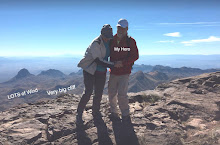
When my wife and I reached Kittaniny Ridge today while on the Appalachian trail, I realized how frequently I overlook the natural beauty of New Jersey. As a lifelong resident of this remarkably diverse State, I suppose I'm not alone. Taking things for granted that we know well is common.
But standing on that ridge looking down at the full bloom of fall in the Delaware Water Gap, I was reminded how awestruck I was just a month ago with the beauty of Tuscany. Here, less than two hours from home, following a six mile hike, I was gazing at a sight of equal splendor. Shame on me.
Hiking down, my reflections turned to other things needing more of my attention. Foremost among those things? People I've taken for granted. My strategy? A sage piece of wisdom learned from a new friend this past summer: Begin again; always begin again. On a perfect autumn day in New Jersey, what could be easier?
When my wife and I reached Kittaniny Ridge today while on the Appalachian trail, I realized how frequently I overlook the natural beauty of New Jersey. As a lifelong resident of this remarkably diverse State, I suppose I'm not alone. Taking things for granted that we know well is common.
But standing on that ridge looking down at the full bloom of fall in the Delaware Water Gap, I was reminded how awestruck I was just a month ago with the beauty of Tuscany. Here, less than two hours from home, following a six mile hike, I was gazing at a sight of equal splendor. Shame on me.
Hiking down, my reflections turned to other things needing more of my attention. Foremost among those things? People I've taken for granted. My strategy? A sage piece of wisdom learned from a new friend this past summer: Begin again; always begin again. On a perfect autumn day in New Jersey, what could be easier?
Friday, October 19, 2012
Warning: Weird Post Ahead
Some months back, I had an odd premonition about someone I'd just met. For some reason, an innocent remark made me think "Ooh, this person once had a torrid love affair." Have you ever had thoughts like this about someone you hardly knew?
Since I've never considered myself at all psychic, the incident stuck with me. And now I've recently noticed a side effect. During several otherwise routine interactions with others, both with people I know pretty well and some I don't, I've found myself wondering: "Has this person ever had a torrid love affair?" When this happens, I'm distracted. It's a little disconcerting, especially in the middle of a mundane conversation.
If I were bold, I guess I could start asking people. How do you imagine people would react? How would you? Everyone has a story but I'm pretty sure that part of their story most people would not share. I'm especially nervous about asking the person who first put me on this weird track months ago. If it turned out I was right, future interactions with many others could be really weird. Actually, this post is pretty weird.
Since I've never considered myself at all psychic, the incident stuck with me. And now I've recently noticed a side effect. During several otherwise routine interactions with others, both with people I know pretty well and some I don't, I've found myself wondering: "Has this person ever had a torrid love affair?" When this happens, I'm distracted. It's a little disconcerting, especially in the middle of a mundane conversation.
If I were bold, I guess I could start asking people. How do you imagine people would react? How would you? Everyone has a story but I'm pretty sure that part of their story most people would not share. I'm especially nervous about asking the person who first put me on this weird track months ago. If it turned out I was right, future interactions with many others could be really weird. Actually, this post is pretty weird.
Thursday, October 18, 2012
#4: The Mt. Rushmore Series
For those keeping track (right!), carved in stone so far in this series have been peak life experiences, memorable short stories & favorite places visited - four of each, i.e. like Mt. Rushmore. Today - Which four films are solidly lodged in your brain? Don't get clever and say "North By Northwest", OK? My list is chronological.
1.) "I Never Sang For My Father": A mournful but powerfully acted film with Gene Hackman in one of his earliest starring roles. Melvyn Douglas plays the eponymous father.
2.) "The In-Laws": For my money, one of the funniest movies ever made, starring Peter Falk & Alan Arkin. "Serpentine!!" Avoid the Michael Douglas/Albert Brooks remake at all costs.
3.) "Hannah & Her Sisters": No Mt. Rushmore of film would be complete for me without a Woody Allen flick. This is one I cannot shake. It's funny, wise and moving - quite a hat trick.
4.) "You Can Count On Me": About the unconditional love a sister (Laura Linney) has for her lost brother (Mark Ruffalo); two of today's best actors at the peak of their powers; amazing script.
Anyone detect a theme? Though 100% unplanned as I began typing, I'm unsurprised how this turned out and see no reason to change it. Please share your Mt. Rushmore of films with me; I'm still collecting films for the project first referred to in the blog post below from January. Thanks.
http://reflectionsfromthebellcurve.blogspot.com/2012/01/finally-payoff.html
1.) "I Never Sang For My Father": A mournful but powerfully acted film with Gene Hackman in one of his earliest starring roles. Melvyn Douglas plays the eponymous father.
2.) "The In-Laws": For my money, one of the funniest movies ever made, starring Peter Falk & Alan Arkin. "Serpentine!!" Avoid the Michael Douglas/Albert Brooks remake at all costs.
3.) "Hannah & Her Sisters": No Mt. Rushmore of film would be complete for me without a Woody Allen flick. This is one I cannot shake. It's funny, wise and moving - quite a hat trick.
4.) "You Can Count On Me": About the unconditional love a sister (Laura Linney) has for her lost brother (Mark Ruffalo); two of today's best actors at the peak of their powers; amazing script.
Anyone detect a theme? Though 100% unplanned as I began typing, I'm unsurprised how this turned out and see no reason to change it. Please share your Mt. Rushmore of films with me; I'm still collecting films for the project first referred to in the blog post below from January. Thanks.
http://reflectionsfromthebellcurve.blogspot.com/2012/01/finally-payoff.html
Wednesday, October 17, 2012
Nap Time
How do you guard against letting the views of professional opinion makers exert undue influence on you?
Although this is fresh on my mind because of the non-stop yammering of political pundits as the presidential debates unfold, this question has long had me in its grip. Film experts like Roger Ebert or the late Pauline Kael, or omnivorous readers/reviewers like the late John Leonard have spent whole lives examining their respective art forms. So, they clearly possess distinctions about those art forms I do not. Political pundits on both sides can make a similar claim re their expertise vs. my (relatively) less informed views.
Given that, how can you/I separate what we say is "our" view from the influence exerted by the experts? How much is ours vs. theirs? How much does that matter? For me, this is more than an academic exercise. For example, the art form closest to my heart is music. But it's often difficult for me to tease apart where what I've read about a musician or a piece of music begins and my opinion of that same musician or piece of music ends. So as I get older and try to get wiser, I've begun withholding musical criticism unless I'm reasonably sure I arrived at "my" critical opinion largely on my own. But, I'm rarely as sure as I used to think I was. And I know quite a bit about music. I know less about film or books, even less about politics, and next to nothing about many other subjects. Is that the main reason professional opinion makers are needed? I need a nap.
Although this is fresh on my mind because of the non-stop yammering of political pundits as the presidential debates unfold, this question has long had me in its grip. Film experts like Roger Ebert or the late Pauline Kael, or omnivorous readers/reviewers like the late John Leonard have spent whole lives examining their respective art forms. So, they clearly possess distinctions about those art forms I do not. Political pundits on both sides can make a similar claim re their expertise vs. my (relatively) less informed views.
Given that, how can you/I separate what we say is "our" view from the influence exerted by the experts? How much is ours vs. theirs? How much does that matter? For me, this is more than an academic exercise. For example, the art form closest to my heart is music. But it's often difficult for me to tease apart where what I've read about a musician or a piece of music begins and my opinion of that same musician or piece of music ends. So as I get older and try to get wiser, I've begun withholding musical criticism unless I'm reasonably sure I arrived at "my" critical opinion largely on my own. But, I'm rarely as sure as I used to think I was. And I know quite a bit about music. I know less about film or books, even less about politics, and next to nothing about many other subjects. Is that the main reason professional opinion makers are needed? I need a nap.
Sunday, October 14, 2012
Back In School
"I don't take notes on books I read; it makes me feel like I'm back in school."
The above statement, made at a recent meeting I attended, was playing in my head today as I took notes at a "One Day University" event in NYC. I couldn't help wondering - What's wrong with being back in school?
Since 2007, my wife and I have participated in five full day events sponsored by this organization. At each event we've heard between five to seven lectures, about one hour long, usually followed by Q&A. The lecturers are largely from Ivy League schools, many are published authors, all are top notch public speakers. To get an idea of the breadth of subject matter just go on the website. End of commercial.
I've kept my notes from all five events in one notebook to re-read each time I return. Doing so during a break today I was struck by how much I've been exposed to being back in school this way. I'm not that concerned about how much I've retained; I can open that notebook randomly any time and find a gem without fail. To wit:
From 10/4/09: What Can We Learn From The Ancient Philosophers? Dr. Tamar Gendler (Yale) quoting Cicero: "Friends half our suffering and double our joy". Now remind me again - What's wrong with being back in school?
The above statement, made at a recent meeting I attended, was playing in my head today as I took notes at a "One Day University" event in NYC. I couldn't help wondering - What's wrong with being back in school?
Since 2007, my wife and I have participated in five full day events sponsored by this organization. At each event we've heard between five to seven lectures, about one hour long, usually followed by Q&A. The lecturers are largely from Ivy League schools, many are published authors, all are top notch public speakers. To get an idea of the breadth of subject matter just go on the website. End of commercial.
I've kept my notes from all five events in one notebook to re-read each time I return. Doing so during a break today I was struck by how much I've been exposed to being back in school this way. I'm not that concerned about how much I've retained; I can open that notebook randomly any time and find a gem without fail. To wit:
From 10/4/09: What Can We Learn From The Ancient Philosophers? Dr. Tamar Gendler (Yale) quoting Cicero: "Friends half our suffering and double our joy". Now remind me again - What's wrong with being back in school?
Saturday, October 13, 2012
The Reading Connection
A decision some years ago to maintain a 1:1 ratio of fiction to non-fiction books has had its challenges, especially when non-fiction subject matter is far removed from my experience. Yet the longer I stick with the practice, the more committed I am to continuing due to a noticeable by-product of my learning: An increased ability to connect with others I might have struggled to engage before.
Just within recent months, "The Wave" (Susan Casey), "The Big Short" (Michael Lewis), & "Animal, Vegetable, Miracle" (Barbara Kingsolver), brought me into the world of surfing, finance, gardening. My previous background in those subjects? Zero. I readily admit only "The Wave" had me enough in its grip that I finished it straight through without reading either a novel or a different non-fiction book at the same time. My difficulties had little to do with the skill of the other two authors. Each time I put off finishing those books, I asked myself: What are you resisting? My consistent answer? Unfamiliarity.
So when I finished both, I was energized by my persistence and eager to engage people who know more than I about finance & gardening. I'd already had excellent results doing exactly that (with surfing) right after I'd finished "The Wave".
Just within recent months, "The Wave" (Susan Casey), "The Big Short" (Michael Lewis), & "Animal, Vegetable, Miracle" (Barbara Kingsolver), brought me into the world of surfing, finance, gardening. My previous background in those subjects? Zero. I readily admit only "The Wave" had me enough in its grip that I finished it straight through without reading either a novel or a different non-fiction book at the same time. My difficulties had little to do with the skill of the other two authors. Each time I put off finishing those books, I asked myself: What are you resisting? My consistent answer? Unfamiliarity.
So when I finished both, I was energized by my persistence and eager to engage people who know more than I about finance & gardening. I'd already had excellent results doing exactly that (with surfing) right after I'd finished "The Wave".
Subscribe to:
Posts (Atom)